
Introduction
Coordinating 8 partners on a laboratory construction project: Adams Nemnye's story, Syensqo
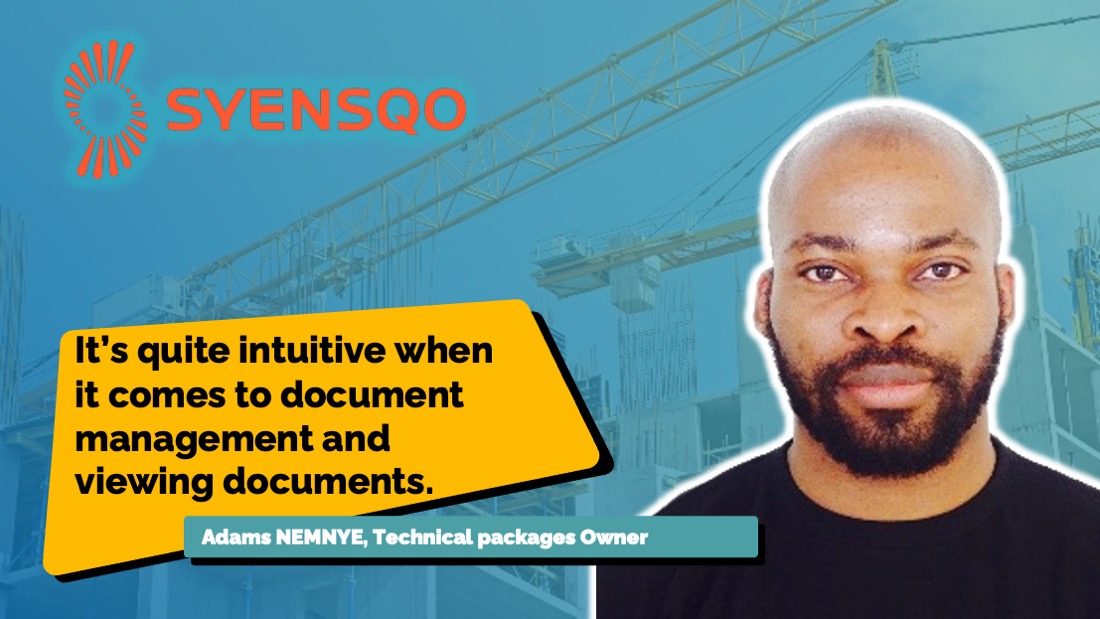
Eight partners. Two years on site. Documents to approve within tight windows so as not to hold up the trades that follow. That was Adams Nemnye's daily reality on the Next Door project. A demanding project that shows clearly what document coordination can cost, or save, on a multi-stakeholder construction site.
Adams Nemnye is technical package owner at Syensqo, and he shares his experience with Cooperlink Construction Hub.
The Next Door project: a relocation, a building and real complexity
Syensqo was born from the separation of Solvay's activities: chemicals on one side, innovation and scientific research on the other. The new entity had to relocate and move into a building designed for it. That is the Next Door project: a building combining office space and a research laboratory area, located in Haren.
Adams Nemnye leads the entire technical scope. His remit: defining the specifications, managing the interfaces with the architecture firm Modulo, and coordinating all the building services contractors. Around him revolve some ten stakeholders: TPF engineering, Spie, Newelec, Glimservice VBS, Arcadis, the inspection body Seco… not forgetting Louis De Waele, in charge of the structural works.
A two-year project, in the construction phase. With everything that implies in terms of document flows, dependencies between work packages and constant coordination.
The challenge: interfaces to manage and deadlines to meet
On Next Door, the complexity did not come from a single factor but from the combination of several.
The project set-up resembled an EPCM model (Engineering, Procurement and Construction Management): Louis De Waele managed the construction of the structural works, while Adams handled the building services in parallel. The problem? The technical contractors could only start once certain parts of the building had been built. Coordination between these two streams was therefore critical: any delay on the structural works immediately impacted the schedules of the trades that followed.
On top of that came the documentation pressure. On a project of this kind, drawings evolve continuously. Each version must be approved within a specific timeframe to avoid knock-on delays. Missing a revision or overlooking a change: the consequences are measured in weeks lost on site.
BIM coordination completed the picture: the models had to be accessible to all stakeholders, with follow-up of comments and progress tracking. A substantial volume of information, involving players with very different tools and working methods.
Why Cooperlink?
It was Louis De Waele who brought Cooperlink into the equation. The structural works contractor was already using the platform for its own document management. Adams, who knew other solutions on the market, got in touch with the Cooperlink team. He attended a presentation and decided to adopt the tool for the building services scope.
“Cooperlink is much simpler. It’s quite intuitive when it comes to document management and viewing documents.”
What it changed in practice
Three points stand out in particular from Adams' experience:
Fast, frictionless onboarding. Cooperlink is simpler and more intuitive than the solutions he had used before. Viewing documents is smooth. Creating new access for partners is done independently, without relying on an external administrator.
Support that responds. This is the point Adams mentions spontaneously, without being asked: support reacts quickly, via chat. On a site where every hour counts, not being stuck on a technical issue makes a real difference. This is exactly what Cooperlink aims to guarantee: a local, reachable team that knows its users' projects.
Drawing version comparison. This is the most concrete benefit Adams highlights, and probably the most telling for anyone managing technical documentation.
“You just compare the versions, you know what has changed, and you focus only on the part that changed. You can make much more effective comments than going over everything from the start.”
On a project where design offices and contractors don't always clearly flag their changes, this feature avoids having to go through an entire drawing to find what has moved. The time saving is immediate. So is the quality of the exchanges.
What this project illustrates
Next Door is not an isolated case. Most large-scale construction projects share the same characteristics: many stakeholders, strong dependencies between work packages, documentation that evolves continuously and unforgiving deadlines.
In this context, coordination does not depend on a miracle tool. It depends on the ability to keep information reliable, accessible and traceable for all stakeholders, at the right time. That is what Cooperlink made possible on Next Door.
Managing a project with multiple trades?
Discover how Cooperlink adapts to your organisation. Request a demo.
What is your project?
Talk to an expert
Tell us more about your project and needs. Our experts will answer your questions within 24 hours.

Laure Bouvier
Project Manager