
Introduction
How to successfully manage work handover: key steps, documents and best practices

The essential stage of work handover
On a construction site, the final stretch often feels exhausting. And when the provisional handover (PH) finally comes around, it is tempting to treat it as a quick administrative formality.
Yet this stage is essential to securing the project from a legal, financial and technical standpoint.
💡You completed the works perfectly, on time and on schedule. But you skipped this so-called “formality”.
Two months later, the client reports a crack in a tile.
Was it caused during the move, or is your subcontractor responsible?
There is no way to determine it.
This article will give you a complete overview of work handover procedures:
- Why carry out a provisional handover of construction works?
- What is a provisional handover? What is a punch list? What is the difference between a provisional handover (PH) and a final handover (FH)?
- When should a PH take place? When can a work handover be refused?
- Where does the handover take place?
- Who is responsible for the provisional handover?
- How is a PH carried out? How do you complete a handover report?
You will learn how to prepare, manage and successfully complete a work handover.
Nota bene: the legal information in this article is based on Belgian public procurement regulations and on the Civil Code for private contracts. The handover is equally important in both public and private projects. Full legal references are provided at the end of the article.
Why properly carry out the provisional handover?
The provisional handover involves several key aspects: legal, financial and technical or safety related.
The legal implications of a work handover
The handover report: the decisive document in case of dispute
If there is one document in your document management system that you must never lose, it is this one.
The handover report officially records the condition of the works and the date on which responsibility is transferred.
💡A water damage incident appears six months after the end of the works.The client blames the contractor. The contractor blames the client for poor maintenance.In court, the judge will request the handover report.
The date of the provisional handover marks the transfer of responsibility
Before the PH, the contractor is responsible for everything that happens on site. At the PH, they symbolically hand over the “keys”.
The client once again assumes responsibility, except when a defect results from poor execution by the contractor.
The construction insurance policy can then be stopped or adjusted.
💡A graffiti mark appears on the brand-new garage door.
Before the provisional handover, the contractor is responsible for cleaning it.
After the provisional handover, the responsibility falls to the client.
The provisional handover marks the start of the warranty period
The PH is the starting point of the contractual or legal warranty (minimum one year).
During this period, the contractor must correct the reported defects.
Once this period ends, the project moves to the final handover.
💡You record the provisional handover of a new hospital on 22/08/2021, with a one-year warranty period.
In July 2022, during the first maintenance inspection, you notice major ventilation defects.
You should not delay sending a registered letter to the contractor.
Soon, it will be too late to invoke the warranty.
The trigger for ten-year liability
The construction warranty or ten-year liability of the general contractor (and the architect) begins at the provisional handover.
If a major issue affecting structural integrity or watertightness appears within ten years, their responsibility remains engaged.
💡The architect who does not feel concerned by this administrative formality may well regret it eleven years later… when a wall collapses.
The financial implications of a work handover

The handover of works ensures the financial security of both parties. Whether for the provisional handover (PH) or the final handover (FH), each stage triggers financial mechanisms that will ease your cash flow.
Release of guarantees and retentions at the handover
When a project begins, the contractor often has to provide a performance bond or retention.
This guarantee protects the client against non-compliance, defects or bankruptcy.
The handover stages determine when these funds are released: generally, half of the guarantee at the PH, and the remainder at the FH.
Final invoicing and payments linked to the handover
At the PH, the contractor may invoice the remaining unpaid works, except for any retentions related to outstanding punch list items.
For the project manager, the services performed up to the PH can also be invoiced.
The same applies to the health and safety coordinator: after the provisional handover, they can finalize the health and safety file and therefore invoice it.
Penalties in case of delays from the contractor… but also from the client
As long as the provisional handover has not been formally recorded, delay penalties continue to run.
In public procurement, penalties are capped. When the cap is reached, an informed client may add additional penalties, which are not capped.
But not everything works against the main contractor: if the client takes too long to draft the handover report, they too may owe compensation.
The technical and safety implications of a work handover
The handover: a guarantee for the client
The PH and the preliminary technical inspections give the client the assurance that the technical installations can be used safely: electrical systems, lifts, sanitary installations, fire alarm systems…
A “snapshot” of the site at a given moment
The provisional handover report guarantees the quality of the installations and serves as a reference in case of disputes or defects detected later.
The provisional handover: a turning point
In short, the provisional handover is the moment when the building changes hands, when the legal and financial clocks start ticking, and when the memory of the project is formally recorded in a report.
Understanding the key concepts: PH, punch list resolution and FH
But what exactly do we mean by provisional handover? And why is it called “provisional”?
What is a Provisional Handover (PH)?
The provisional handover (PH) is the official act by which the contractor declares that the works are completed and the client agrees to take delivery… with reservations.
The core document is the provisional handover report.
The PH confirms that the works are generally compliant with the contract and with good practice, while opening a warranty period.
Why a warranty period? Because it is impossible to check everything on the day itself, and some defects only appear once the building is in use.
Note that if the client takes possession of the premises without an official PH, they are deemed to have accepted the provisional handover without reservations.
What is a punch list resolution or lifting of reservations?
During the PH, defects that do not prevent the safe use of the building may be listed in a punch list attached to the report.
The punch list resolution (or lifting of reservations) is the formal confirmation that the contractor has corrected the defects identified during the PH.
What is a Final Handover (FH)?
The final handover (FH) takes place at the end of the warranty period.
It is the moment when all obligations of the contractor come to an end: the client can no longer claim defects, except in the case of structural damages covered by the ten-year liability.
When should the PH and FH take place?
A construction timeline: from the start of works to the handover
D0 – the start of the project
The official start date is either imposed by the client in a public contract, or mutually agreed upon in a private contract.
This contractually fixed start date is what triggers the countdown, not the actual day on which works begin.
💡Your company receives a registered notice for the renovation of a theatre façade.
The official start date is set for 1 January 2026.
In practice, you begin on 15 January.
The contractual start date remains 1 January 2026.
D – the execution period of the works
The execution period corresponds to the duration initially set in the contract, plus any additional time formally agreed during the project (in rare cases, these adjustments may even be negative).
The execution period may be expressed in calendar days or working days.
💡The execution deadline is 180 days. During the project, a decision is made to add the refurbishment of the rainwater downpipes, with an additional 30-day deadline.
The contractor asks to work on Saturdays in exchange for reducing the deadline by 10 calendar days.
The final execution period is therefore: 180 + 30 – 10 = 200 calendar days.
F – the day the works are completed
It is the contractor who requests the provisional handover once the works are completed (on time… or late).
The official completion date is not the scheduled date but the actual date, including any execution delays (let’s call these D).
D0 + D + R = F
💡Your façade renovation project, which began on 1 January 2026, ends on 30 July 2026, meaning a delay of 10 days compared to the planned date.
You then request the provisional handover.
PH day – the day of the provisional handover
The client has 15 days to officially organise the provisional handover after the actual completion date.
The warranty period, as well as the ten-year liability period, starts on the actual completion date (F), not on the day the provisional handover meeting takes place.
Any remaining remarks must be resolved within a deadline mutually agreed upon. If this deadline is not respected, penalties may be applied.
💡On 10 August, everyone gathers in front of the freshly renovated theatre, and the PH report confirms 30 July as the official completion date.
The warranty period therefore begins on 30 July 2026.
The contractor has 60 calendar days to resolve the remarks and therefore requests the punch list resolution on 28 September 2026, with no delay (phew!).
G – the duration of the warranty period
By default, the warranty period lasts one year.
It is possible to extend this period in the contractual clauses, for example for complex technical installations.
💡For your façade renovation project, the warranty period is set at one year.
FH day – the day of the final handover
The end of the warranty period corresponds to the actual completion date plus the warranty duration.
The final handover must take place no later than 15 days after the end of the warranty period (FH day).
If the final handover is not officially refused, it is considered tacitly accepted.
F + G + ~15 = FH day
💡The façade works are therefore under warranty until 29 July 2027 (one year later).
The final handover report is formally issued on 5 August 2027.
When should the handover be refused?
Refusing a provisional handover: why?
Refusing a PH is possible, but the reasons must be serious.
A simple remark is not grounds for refusal; it will be recorded and resolved after the PH.
Only major non-conformities justify a refusal: unfinished works, structural defects, safety risks, or the use of non-compliant or non-approved materials.
Refusing a final handover: why?
If the remarks listed in the PH report or defects that appeared after the PH and were reported by the client are still not corrected on the day of the final handover, the FH must be refused.
If the contractor refuses or is unable to put things right, the client may, under measures of enforcement, carry out the missing works (either themselves or via a third party).
And this is at the contractor’s expense.
Where and how should the PH be organised?
On-site handover of the works
The provisional handover must of course take place on site. It is essential.
All rooms, areas and installations must be visited and checked thoroughly.
This requires preparation beforehand. On large projects, dividing the site by lots will be a relief for your feet. Yes, a provisional handover is a sporty exercise.
Even if they have no legal value, preliminary technical inspections can be extremely useful.
Off-site handover of the works
Document checks are carried out off site.
If you use a dedicated document management tool (such as the solution offered by Cooperlink), you avoid sorting through messy paper files or searching your server for every technical sheet (see our ebook on the as-built file).
And what about the final handover?
Unless there are defects to inspect together on site, you can organise it comfortably in your office.
Who is involved in the PH?
The handover of works involves the responsibility of almost everyone on the project.
Each stakeholder has their own duties, but all work toward the same goal: a smooth, surprise-free provisional handover.
You are the client?
You attend the site inspections (no, do not simply send your architect in your place), draft and validate the reports, apply penalties, release the guarantees…
At the final handover, it is your responsibility to formally confirm acceptance or refusal to the main contractor.
You are the project manager (architect or engineer)?
You proactively attend the on-site inspections: advise the client, check the compliance of the works and the end-of-project documentation.
Then, during the warranty period, you verify the punch list items and analyse any defects.
You are the main contractor?
It is your responsibility to request the PH from the client once the works are ready for handover.
You attend the inspections and correct the initial non-conformities or those reported before the final handover.
If the final handover is refused, you must inform the client once the works are again ready.
You are on site as a site manager?
You think this formality does not really concern you? Think again. Your role starts well upstream.
To avoid surprises for your manager, you organise internal handovers with your subcontractors, prepare the cleaning and clearing of the site so that inspections run smoothly.
After the handover, the technical follow-up of non-conformities will also be your responsibility.
How to carry out the PH, the punch list resolution and the FH?

What are the steps of a provisional handover?
- The contractor submits a handover request to the client.
- All installations and rooms are inspected thoroughly.
- The stakeholders check the compliance of the works with the specifications, good practice and safety requirements (lifts, fire systems, ventilation, etc.).
- Remarks and defects to be corrected are recorded.
- The As-Built file (or Executed Works File) is checked to ensure completeness.
- A handover report (or a refusal report) is issued.
- Once the corrections are made, a new site visit confirms that all remarks from the PH have been resolved.
- A punch list resolution report is then drafted.
What are the steps of a final handover?
- The client verifies that all remarks from the PH have been resolved.
- The client checks that any defects that appeared during the warranty period and were reported have also been resolved.
- The client drafts a final handover report (or a refusal report).
- If no action is taken, the final handover is tacitly approved.
What does the handover report contain?
During a work handover, you will encounter 3 or 4 types of reports:
- The provisional handover report,
- The provisional handover refusal report (hopefully not for you),
- The punch list resolution report,
- The final handover report.
All these reports must include:
- A clear title (provisional handover, refusal, etc.),
- The date of the inspection,
- The persons present,
- The list of inspected works,
- Confirmation that the works can or cannot be accepted, or that the remarks have been resolved,
- The signatures of all parties involved (client, project manager, main contractor).
For the PH report specifically:
- The official completion date,
- The full list of remarks,
- The deadline for resolving them,
- Any amount withheld until the remarks are resolved.
For the PH refusal report:
- The justified reasons for refusing the handover,
- The deadline for compliance,
- Any additional penalties defined in the contract in case of delay.
For the punch list resolution report:
- Any penalties due to delays beyond the agreed deadline,
- The green light to invoice the amounts that were withheld.
For the final handover report:
- The date of the provisional handover,
- The official completion date.
Final practical tips for an efficient handover
- Do not improvise: plan the PH well in advance, organise internal or technical pre-inspections and define a clear route to stay efficient.
- Be exhaustive: inspect all areas and systems, floor by floor.
- Document clearly: structure photos and notes to make punch list resolution easier (or use a dedicated tool such as Cooperlink Construction Hub).
- Prioritise the punch list items: you can group remarks into packages with different deadlines.
- Communicate efficiently: instead of sending the entire punch list to all subcontractors, target who receives what to clarify responsibilities.
- Consult experts: confirm with all stakeholders that the corrections are compliant.
- Make the handover pleasant: start with a hot coffee, plan snack breaks and, why not, end with a restaurant to celebrate the end of the project.
Cooperlink simplifies the provisional handover and punch list resolution
The end of a project is often an intense period: gathering documents, tracking remarks, coordinating multiple stakeholders. And on top of that, the Excel punch list crashes, the As-Built file has to be reconstructed by digging through emails, and the hunt for the latest approved version begins… pure chaos.
Cooperlink offers a simple and effective solution: a platform that centralises documentation, tracks every remark in real time and streamlines validations.
- Automated As-Built and DOE files: created and enriched from the design stage, ready by handover time.
- Automated tasks: assignment, notifications and full history. No more disappearing Excel rows.
- Subcontractor portal: instant document upload and access, without endless email chains.
- Approval workflows: full tracking of corrective actions until all remarks are resolved.
- Integrated e-signature: validate and sign handover reports without printing or delays.
- Automated reports: generated in one click, customised for each use.
- Mobile field app: real-time tracking, add remarks via QR code, update statuses instantly.
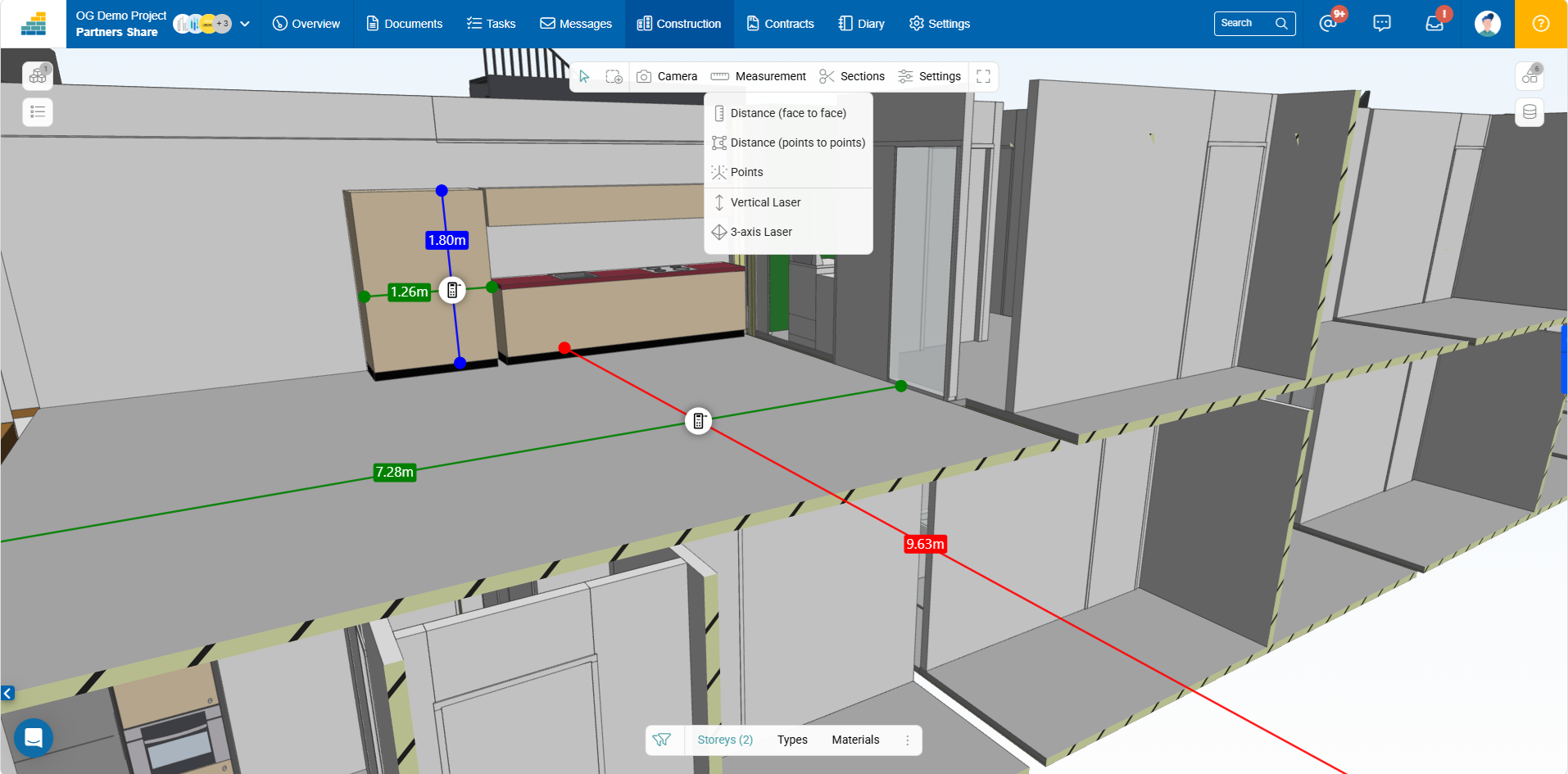
- Geolocated observations on 2D/3D plans: every remark is clearly identified and assigned.
- BIM integration: each observation remains tied to the relevant asset for full traceability.
In summary, work handover is…
- An essential stage, impossible to overlook.
- The assurance that the delivered works are compliant, safe and validated by all parties.
- A structured process in several steps:
- The provisional handover (PH), which formalises the end of the project and opens the warranty period.
- The punch list resolution, essential for quality control.
- The final handover (FH), which closes the contract and releases the guarantees.
- A procedure that involves all project stakeholders: main contractor, site manager, architect, client, health and safety coordinator…
- A phase that can quickly become time-consuming without preparation or proper tools. With Cooperlink, handover and punch list resolution become simple, collaborative and fully secure.
Note on references
The legal information is primarily based on Belgian legislation for public procurement:
- Royal Decree of 18 April 2017 on the award of public contracts in the classic sectors
- Royal Decree of 14 January 2013 establishing the general rules for the execution of public contracts
- Article 64: principle of handovers
- Articles 129 and 131: deadlines
- Article 134: warranty period
- Article 135: final handover
- Articles 33 and 93: release of guarantees
- Article 152: responsibility of the project manager
- Article 52: claims by the main contractor
- Article 82: refusal of products
Belgian Civil Code, Book V:
- Articles 1792 and 2270: ten-year liability
- Articles 5.71 to 5.73: contract execution
- Article 5.86: enforcement measures
- Article 5.258: guarantees
For France, please refer to:
- The French Public Procurement Code
- The French Civil Code, Book III
What is your project?
Talk to an expert
Tell us more about your project and needs. Our experts will answer your questions within 24 hours.

Natacha Louis
Content writer