Introduction
Building maintenance plan: how to plan ahead from day one on site?
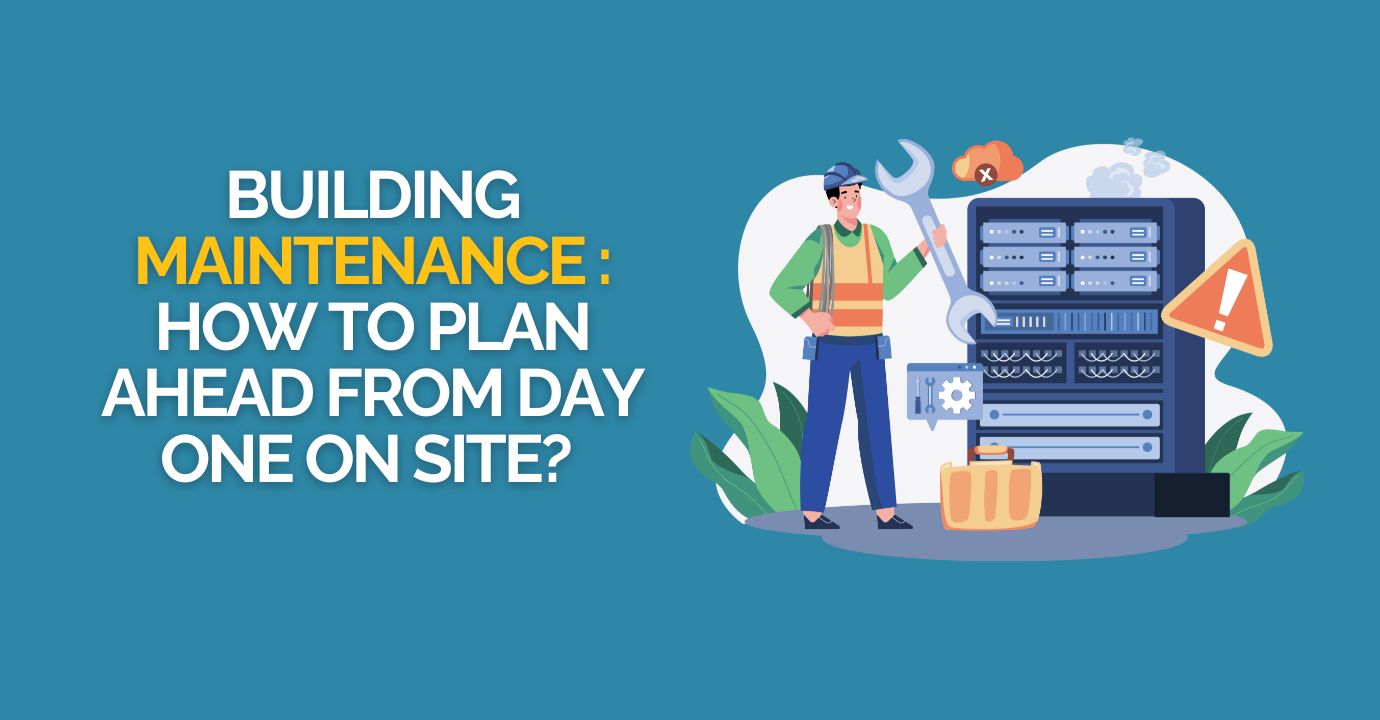
Unloved and often sidelined, building maintenance is frequently overlooked by project owners.
As a result, technical teams are left to improvise with whatever data they manage to gather and whatever resources they are given.
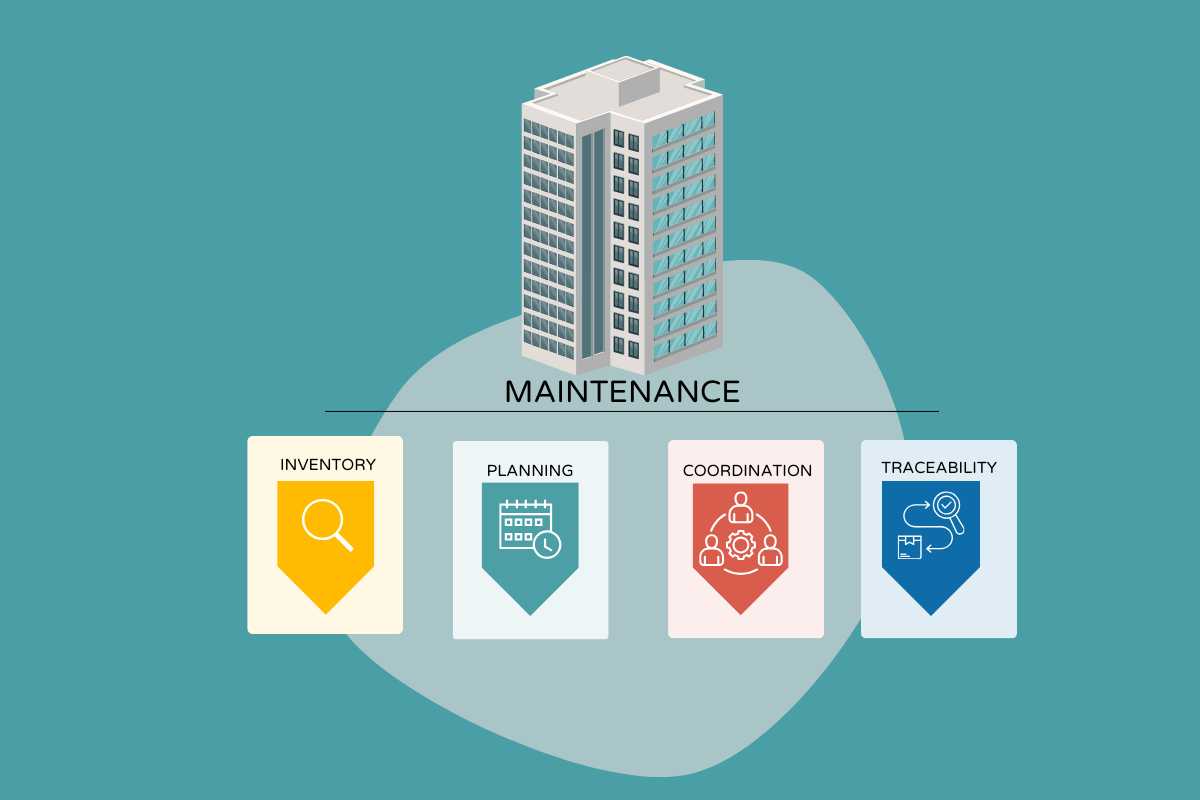
Yet preparing a building’s maintenance strategy is far from complex. Ultimately, it all comes down to data and documentation:
- Factual data: assets, their characteristics, and their technical or legal requirements. This is the first pillar: inventory.
- Strategic data: priorities, maintenance types, and maintenance frequencies. This forms the second pillar: planning.
- Human-resource data: responsibilities, contracts, contacts, and collaboration workflows. This is the third pillar: coordination.
- Documentation: informative (data sheets, drawings, diagrams), prescriptive (maintenance plans, roadmaps, specifications), or evidential (reports, records). This constitutes the fourth pillar: traceability.
This article will clarify these four pillars and show how they form the basis of well-prepared maintenance.
But first, let’s start with one essential question…
What is maintenance?
Maintenance includes all actions intended to keep a building and its systems in operational condition or to restore them when necessary. It extends the lifespan of components and equipment while ensuring user comfort and safety.
A few examples:
- Annual inspection of a ventilation system, including filter cleanliness checks and, depending on their condition, replacement or cleaning.
- Biannual inspection of elevators by a certified company.
- Seasonal checks of outdoor installations to prevent degradation and accidents.
- Replacement of fire extinguishers every ten years (based on the manufacturing date).
Why anticipate maintenance as early as the construction phase?
Failing to plan maintenance during the construction phase will quickly become painful:
- For users: the first tenants move in and the elevator breaks down, doorbells malfunction, and no one can be reached.
- For technical teams: they take over a new building and must assemble everything from scratch while also managing early-stage defects.
- For your building: five years later, the ventilation system shows signs of fatigue (clogged filters, damaged motor...) and repair costs become significant.
Planning maintenance during the construction phase makes it possible:
- To select accessible and durable equipment (why not in consultation with technical teams?)
- To centralize all required information (document management)
- To prepare service contracts in advance, including those covering the first years under the contractor’s responsibility
- To facilitate the handover between construction teams and facility management teams
The Design-Build-and-Maintain (DBM) approach offers an alternative way to anticipate maintenance from the construction phase: the company that designs and builds the project is also responsible for maintaining it for a defined period. This forces them to think ahead by selecting accessible equipment, choosing durable materials, and centralizing documentation.
The 4 pillars of maintenance
By building these four pillars one by one, you lay the foundations for effective and meaningful maintenance:
- Pillar no. 1: Inventory, collection of factual data (assets, location, category, maintenance requirements, legal maintenance obligations)
- Pillar no. 2: Planning, development of decision-making data (strategy, prioritization, maintenance types, frequencies)
- Pillar no. 3: Coordination, management of human resources (delegation, team organization, external inspections)
- Pillar no. 4: Traceability, centralization of documentation (technical documents, organizational documents, evidence records)
Pillar no. 1: Inventory
Before planning anything, start by simply taking stock of what already exists.
Inventory of elements
When we think of maintenance, we tend to think only of technical equipment: ventilation systems, boiler rooms, elevators… But buildings also include joinery, finishes, and furniture that require regular attention.
A few examples by trade:
Structural works: cleaning and upkeep of exposed concrete elements
Joinery: checking and lubricating locks and opening mechanisms
Electrical: inspection of electrical panels and tightening of connections
HVAC: inspection of control systems
Sanitary installations: detection and repair of leaks
Fire safety: periodic testing of mechanical and natural smoke extraction
Outdoor areas: cleaning gutters and drainage channels
Be precise: if you only write “boiler room”, you will end up grouping together multiple maintenance actions across different trades, frequencies, and regulations.
For each element, you should collect: its category (electrical, fire safety…), the element itself, its location, and its technical references.
Inventory of technical and legal requirements
Your next step is to collect the maintenance requirements for each element. To do this, you will rely on several sources (*the standards mentioned below apply to Belgium):
- Technical data sheets, which provide guidance on maintenance frequency and conditions
- Manuals, detailing parts to be replaced and maintenance procedures
- Industry standards and professional best practices
- Regulations such as the General Regulations on Electrical Installations (RGIE) and the Royal Decree of 9 March 2023 concerning elevators
- NBN standards such as NBN S21-050 for fire extinguishers or NBN S21-100 for fire detection systems
- Regional regulations, including boiler maintenance obligations and housing codes that define how maintenance responsibilities are shared between owners and tenants
- Technical guides such as the Sustainable Building Maintenance Guide published by Bruxelles-Environnement
You will then complete your dataset with: whether maintenance is mandatory or not, applicable technical requirements, and recommended or mandatory maintenance frequencies.
You will also collect key documents: technical data sheets, drawings, and diagrams.
How and why should you start working on this pillar during the construction phase?
You have certainly noticed it: the amount of information to gather is enormous. You may think the process will be tedious. Here is the good news: most of this rigorous work is already carried out during the construction phase. The list of elements, technical data sheets, drawings, locations… all of this is produced progressively.
With just a bit of extra organisation on site, your maintenance database will be ready to use on the day of provisional acceptance. Quite a time-saver, isn’t it?
Use the right tools for inventory
To make your inventory effective, avoid any tool that does not allow proper sorting, filtering, or labelling. If you choose a simple spreadsheet (like Excel), make sure all data is consolidated in a single structured table, with separate columns for each type of information and segments to filter.
However, an inventory is more than a list of equipment. A complete inventory forms a map of the building, integrating not only the equipment but also technical and legal requirements through associated documents.
The Cooperlink platform centralizes all this information: technical data sheets, photos, inspection records, acceptance documents, and drawings. The inventory becomes dynamic, accessible to all project stakeholders and future maintenance teams. Thanks to its element-based data management, Cooperlink makes it easier to create a comprehensive list of all items to be maintained.
Pillar no. 2: Planning
Now that you have built the first pillar using the building’s data, it is time to develop a pillar based on strategy and choices, on the “when” and the “how”. The final outcome of this planning phase? The maintenance plan.
Defining a maintenance plan strategy for your building
A maintenance plan is much more than a schedule of interventions: it is a strategic document that organizes all preventive and corrective actions to extend the building’s lifespan.
Designing a maintenance plan means anticipating constraints, ranking priorities, and mobilizing the right resources: human, technical, and financial.
Before detailing specific operations, start by defining your main strategic direction:
- Do you want a sustainable maintenance approach, focused on energy performance and waste reduction?
- A smart maintenance approach, supported by data and connected monitoring systems?
- A premium maintenance approach, designed to maximize user comfort?
- Or the bare minimum, centred on regulatory compliance and cost control?
These choices will determine everything else: frequency, tools, team training, and budget.
Prioritizing maintenance interventions with the MoSCoW method
In the first pillar, you already created a detailed list of elements to maintain and linked them to legal and technical requirements. In other words, objective, non-negotiable data.
This second pillar forces you to make choices. Because no, you will not be able to do everything!
Based on your overall strategy, you will now answer several questions:
- Which tasks are critical and absolutely must be carried out?
- Which interventions are desirable but not urgent?
- Which actions can be postponed?
The MoSCoW method clarifies these priorities:
- “Must have” for essential obligations (annual elevator inspection)
- “Should have” for highly recommended actions (biannual cleaning of ventilation filters)
- “Could have” for desirable but non-urgent interventions (visual inspection of exterior joinery)
- “Won’t have” for actions to postpone or exclude (repainting the stairwell)
Other prioritization methods also exist, such as weighted criteria, the Cost-Benefit matrix, risk criticality grids, or the ABC method.
For each element, you will therefore specify its level of priority.
The 5 types of maintenance
Based on your priorities, you will define the maintenance approach for each element.
We propose a method inspired by the five maintenance types commonly used in the industrial sector. These five types fall into two main philosophies: corrective (fixing issues when they occur) and preventive (anticipating issues to avoid them).
In the short term, corrective maintenance is the easiest to implement. In the medium and long term, preventive maintenance increases the durability of components and reduces replacement frequency. In addition, emergencies are costly: financially and humanly (stress, credibility…).
- Corrective maintenance – palliative: this refers to emergency repairs and temporary fixes that restore service quickly. A reset, a cable tie, a bit of engineering tape, an OSB board… anything that gets things running again for the short term.
- Corrective maintenance – curative: this is a durable repair that addresses the root cause, such as replacing an entire heating pump to prevent the issue from recurring.
- Preventive maintenance – systematic: interventions planned according to a fixed schedule. For example: annual elevator inspections, filter replacement every six months, parquet oiling every two years…
- Preventive maintenance – condition-based: monitoring the condition of equipment and intervening only when necessary. For instance: inspecting exterior joinery to check whether hardware needs replacement or lubrication.
- Preventive maintenance – predictive: using sensors and data analysis to anticipate failures. Online monitoring systems, for example, can send automatic alerts about heating system performance.
The ideal approach is a careful mix of these five maintenance types. You will define your own recipe based on your strategy, priorities, and resources.
How to create a maintenance plan?
Once your priorities are defined and your maintenance types selected, it is time to move on to the concrete construction of the maintenance plan. This plan is your operational roadmap: it translates strategy into specific actions, scheduled and monitored over time. Return to your inventory and enrich it
For each element of the building, specify:
- The type of maintenance (corrective, systematic preventive, condition-based, or predictive)
- The frequency of interventions (annual, semi-annual, monthly, …)
- The monitoring indicators (wear levels, energy consumption, noise, performance, alarm signals…)
- Any special conditions (access, safety, building downtime periods, dependencies with other systems)
Finally, a maintenance plan is never static. Schedule an annual review to adjust frequencies based on the actual condition of equipment, incorporate feedback from field teams, and update costs and priorities.
How and why should you integrate this pillar during the construction phase?
If your maintenance plan is drafted in parallel with the construction phase, you will be able to continuously document all future maintenance needs. Anticipating maintenance during construction also allows you to prepare and budget your maintenance plan as early as possible.
In addition, integrating maintenance into technical and architectural decisions (technology choices, maintenance spaces, access planning…) will prevent last-minute modifications.
For condition-based or predictive maintenance, installing sensors and monitoring systems during construction is always less costly than dismantling ceilings or intervening on systems still under warranty.
Which tools should you use to write and manage a maintenance plan?
The most basic tool, found in every workshop, is the classic whiteboard. It is large, visible on site, flexible, and usable directly by teams without digital skills. However, manual tracking quickly reaches its limits.
Excel or Google Sheets allow shared and editable tracking. With features like VBA or mail merge, you can generate summaries, reports, or roadmaps. But this requires specific skills and can rapidly become overly complex.
Kanban-style systems, such as Trello or Google Tasks, automate deadline alerts. They are easy for teams to use, but too limited to manage an entire building with a comprehensive maintenance strategy.
For installations such as boiler rooms, smart systems and home-automation platforms often include their own software or online dashboards.
The real challenge is therefore not finding a tool, but avoiding fragmentation: too many disconnected tools lead to omissions, duplication, and administrative fatigue.
The solution? Centralize all information in a single platform that gives you a clear overview of the building’s condition, planned actions, and responsibilities. Depending on your global maintenance strategy, investing in a CMMS (Computerized Maintenance Management System) may be appropriate.
If you used Cooperlink during the construction phase, transitioning from construction document management to a maintenance management system will be significantly easier thanks to the platform’s structured data extraction.
Pillar no. 3: Coordination
You have built your maintenance plan… Great. But how do you organise it? Who is responsible? Who handles the work? Who grants access? This is the purpose of the third pillar.
Maintenance is not just about scheduling interventions: it requires effective coordination between all stakeholders.
To delegate or not to delegate maintenance… that is the question
Choosing to internalise maintenance has several advantages:
- Full control over interventions
- In-depth knowledge of the building
- Quick response to unexpected issues
However, it requires training staff, planning their availability, and investing in tools and equipment.
Outsourcing reduces the workload of internal teams and brings specialised expertise. But it also requires rigorous monitoring of contracts and interventions. Delegating maintenance does not remove your responsibility for the building.
Engaging stakeholders
Whatever your choice (internal or external), involve the teams from the very beginning. Technicians, facility managers, and site supervisors must share a clear understanding of priorities, responsibilities, and deadlines.
Beyond your teams, involve all stakeholders in the responsibility for maintenance. For example, formalise and communicate which maintenance tasks fall under the responsibility of the building’s tenants.
Mandatory inspections
Some installations, such as elevators or boilers, require mandatory inspections by an External Technical Control Service (SECT). Check whether these companies contact you automatically or whether you must reach out to them. In any case, you remain solely responsible as the building owner.
Which tool should you use to coordinate stakeholders?
Your maintenance plan now includes additional human-related data:
- Internal responsible person (there is always someone internally who ensures that services are carried out, and carried out correctly)
- Execution of maintenance: internal or external
- If internal, which teams?
- If external, which company?
- Contact person for access and/or technical information
- Contractual information (start and end dates, terms…)
That’s a lot of data indeed!
If your maintenance plan is “manual”, use a RACI matrix (link to future article) to formalise roles and responsibilities.
With a spreadsheet-based plan, add columns for human and organisational data.
With a task-based maintenance plan, assign tasks to the appropriate responsible person. If you use scheduling software, plan the appropriate shifts.
Ideally, you should use a dedicated tool that centralises everything and transforms your maintenance operations into assigned, tracked, and validated tasks.
.png)
Pillar no. 4: Traceability and documentation
Once all the data from the first three pillars has been assembled, you can build your documentary system: informative (technical data sheets, drawings, diagrams), prescriptive (maintenance plan, roadmaps, specifications, contracts), or evidential (reports, tests, certificates…). Traceability and documentation form the foundation of all effective maintenance. This is the fourth pillar. Without it, the system you have put in place will collapse.
The entry point to maintenance: the As-Built file
Before any intervention, you must know exactly what is being maintained. This is the role of the As-Built file, which centralises all the information needed to understand, locate, and maintain every component of the building.
What maintenance teams expect:
- Autonomy: the ability to consult data without depending on the project manager
- Accessibility: quickly finding information on a centralised platform
- Clarity: easily identifying each piece of equipment
- Exhaustiveness: including drawings, manuals, warranties, records, and useful contacts
Too often, key information gets lost between construction and operation. A structured and up-to-date As-Built file ensures effective maintenance from day one.
Prescriptive documents related to maintenance
For maintenance to be effective, it must rely on clear, prescriptive documentation. These documents define the actions to be taken, the responsibilities, the frequencies, and the procedures.
- The maintenance plan is THE reference document. It defines what to maintain, when, how, and by whom. It gathers all preventive and corrective actions to be carried out on the building, their frequency, priorities, etc.
- The specifications : they describe the technical, administrative, legal, and performance requirements applicable to maintenance. They include obligations, standards, quality criteria, and control procedures.
- Maintenance contracts: they formalise the commitments between the owner, the building manager, and/or service providers. They specify responsibilities, intervention deadlines, costs, warranties, and termination conditions. These are the legal and operational foundations of maintenance.
- Roadmaps (or intervention checklists): they detail the concrete tasks to be performed on site. They support technicians in planning, tracking, and documenting each operation. These are the everyday tools of maintenance teams.
Evidential documents
Evidential documents are those that demonstrate that maintenance operations were carried out in compliance with legal, contractual, or technical requirements.
- Intervention reports: description of the work performed, date, location, technician, observations, parts replaced, adjustments made, functional tests.
- Regulatory certificates and attestations: for example, periodic electrical inspection certificate (RGIE), elevator inspection certificate, fire extinguisher compliance certificate…
- Records and technical measurements: results of analyses (e.g., boiler efficiency), data from sensors or technical supervision systems.
- Other supporting documents: intervention logs, tickets, sensor logs.
How and why should you start working on this pillar during the construction phase?
Documentation and traceability are not built at the end of a project but from the very first shovel of earth. Every drawing, data sheet, or diagram properly stored from the beginning saves valuable time during maintenance.
Because it is during the construction phase that you have:
- The most accurate information on materials, equipment, and settings
- The key actors (contractors, subcontractors, suppliers) able to document their interventions
- Opportunities to integrate the right monitoring tools directly into the project
A rigorous and centralised documentation management system
A solution like Cooperlink transforms the As-Built file into a living tool that supports maintenance.
Gone are the binders forgotten in a cupboard: all information is centralised, accessible, and updated in real time.
Concretely, this allows you to:
- Gather in a single place the latest approved versions of drawings and technical data sheets
- Provide each stakeholder (maintenance, management, operations) with tailored access to the data and documents relevant to their role
- Smoothly manage the transition between construction and operations
.png)
Conclusion: a building that is easy to maintain, starting from the design phase
The table below provides an at-a-glance summary of the four pillars of maintenance.
Anticipating maintenance during the construction phase ensures occupant comfort and safety, respects the expertise of maintenance teams, and extends the building’s lifespan.
The four pillars — inventory, planning, coordination, and traceability — structure and strengthen the effectiveness of your maintenance approach.
Solutions like Cooperlink provide a central point for all construction data, from site records to technical manuals, contracts, and acceptance documents. They enable project owners to shift from reactive maintenance to a structured and anticipatory maintenance strategy.
What is your project?
Talk to an expert
Tell us more about your project and needs. Our experts will answer your questions within 24 hours.

Natacha Louis
Content writer